$$PLAIN_TEXT_PREVIEW$$

Weekly Dispatch, 17 November

From the PalFest Podcast:

Resisting Erasure: Capital, Imperialism and Race in Palestine

In the third instalment of The PalFest Podcast, we are excited to bring you Laleh Khalili, the esteemed professor and writer in conversation with the authors of Resisting Erasure: Capital, Imperialism and Race in Palestine; Adam Hanieh, Robert Knox & Rafeef Ziadah.

Resisting Erasure is a succinct and far-reaching critique of the socio-economic and political forces that sustain the Israeli settler-colonial project. Challenging mainstream narratives that reduce Palestine to ancient hatreds, humanitarian tragedy, or legal abstractions, Resisting Erasure places Israeli settler-colonialism within the broader historical arc of imperialism, race, and fossil capitalism in the Middle East.

In their wide-ranging conversation, Khalili and the authors of Resisting Erasure, they discuss the book, the racial capitalist logics of Zionism, the problem of recognition, and the Marxist political tradition undergirding the struggle for Palestinian liberation.

This episode was recorded between Exeter, Beijing, Liverpool and London on October 13th, 2025.

Find out more about the PalFest Podcast, and look out for past (and future!) episodes, on our website.


Global Reading for Freedom of Expression and Solidarity with Palestine, 29-30 November

On November 29-30, 2025, a coalition of independent presses, poets, writers, and translators will hold a 24-hour Global Reading for Freedom of Expression & Solidarity with Palestine.

This annual event has become a powerful and moving show of unity – poetry knows no borders and can speak powerfully for the right to free expression. Poetry bears witness!

Readers and attendees will convene online, beginning with Palestinian poets in Palestine and following the sun. As one part of the world rests, another will continue. Participants will share poems in their preferred language, affirming the collective power of words and calling for an immediate ceasefire.

We remain committed to freedom of expression and stand with those facing violence and oppression. We invite supporters and allies to join us beginning at 15:00 Palestinian time (EET) to renew the call for global solidarity through poetry, language, and collective resistance.

Find out more from Pamenar Press.


London Palestine Film Festival, now through 28 November

From 14–28 November, the London Palestine Film Festival returns with a bold programme amplifying Palestinian voices and visions.

This year spotlights Gaza, opening with The Voice of Hind Rajab, Oscar-nominated Kaouther Ben Hania’s urgent and harrowing film that tells the final moments of six-year-old Hind Rajab during the bombardment.

Among this year’s highlights are the UK premieres of Once Upon a Time in Gaza by Arab and Tarzan Nasser and The Mission, a raw, unflinching testament to Gaza’s operating rooms under fire, attended by Dr Mohammad Tahir and Producer/Director Mike Lerner.

The festival closes with two special events: a shorts programme at ICA London exploring sound, silence and survival in Gaza, and All That’s Left of You at Riverside Studios, Jordan’s official submission to the Academy Awards, directed by Cherien Dabis.

Check out the full program and reserve your tickets here.


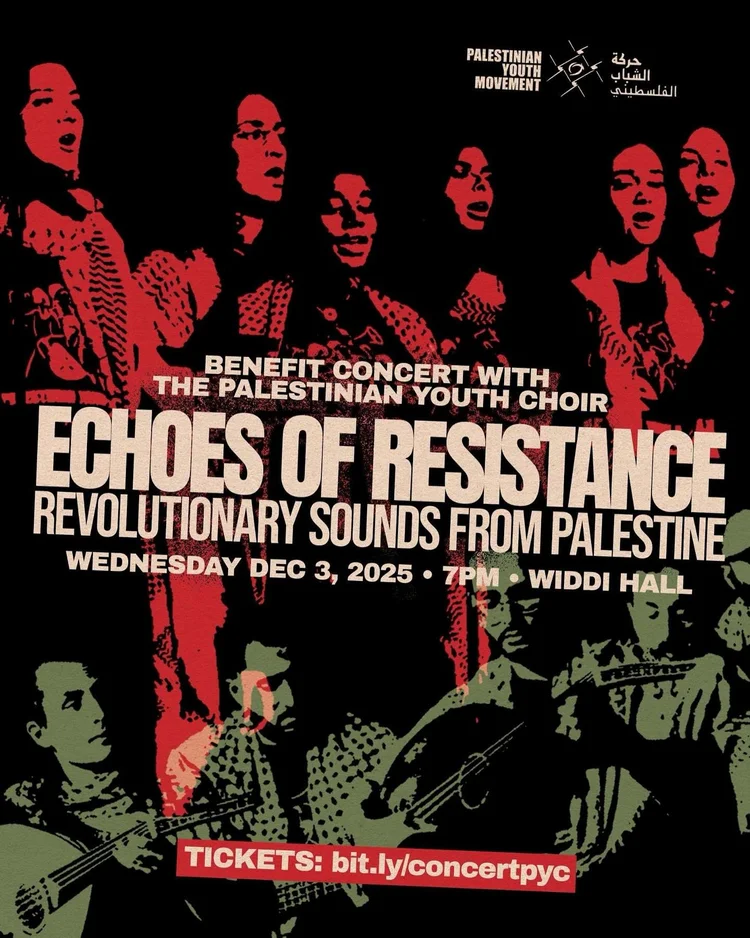
NEW YORK: Echoes of Resistance: Revolutionary Sounds from Palestine, 3 December

Revolutionary music has always been the soul of Palestinian resistance — a defiant echo of Sumud and an unyielding cry for freedom.

Join Palestine Youth Movement at Widdi Catering Hall in Brooklyn for Echoes of Resistance: Revolutionary Sounds from Palestine, an evening showcasing the rich heritage of Palestine through music, art, and performance. This program will feature a NYC-debut performance by the NYC Palestinian Youth Choir, a PYM project that brings together youth from the diaspora to revive and preserve Palestinian culture, history, and the spirit of resistance through music.

Light refreshments will be served, and the event will feature vendors, art exhibitions, a raffle, and more. All proceeds from the evening will go to supporting the work of Middle East Children’s Alliance in Gaza.

Find out more and get your ticket here.


Book of the Week

Samer Abu Hawwash is the solemn yet glinting revelation of a seer by circumstance; his poetry is prophetic because it remembers—is remembering—not only the past, but the future, that is, the ruins, in which is reflected, as in a thousand scattered mirrors, the lucid, inextinguishable soul of everything that once was. Rendered in immediate, tactile, moving translation by the dauntless, extraordinary Huda Fakhreddine, this is poetry as visionary intimacy: the carrying of the soul “on the edge of this abyss, that is the world.”

–Brandon Shimoda

In Ruins and Other Poems, Samer Abu Hawwash stands upon ancient and modern ruins, engaging with the archetypal Arabic qasida and its echoes in the present, set against a backdrop of exile, displacement, and genocide.

The site of the ruin, the journey, and the return home are the three movements of the archetypal Arabic form with which Samer contends in his book-length poem. Writing in and from the moment of crisis, the poet keeps returning to ruins, forfeiting the journey and the hope of return and resolution, rearranging the elements of poetry in the Arabic tradition in search of closure or consolation—in a gesture, a shadow, a memory, an object.

The five poems that follow “Ruins” in this book root themselves in monumental loss. When “it no longer matters if anyone loves us” and “we will lose this war,” nothing remains but the poem, the witness, the signpost in the wasteland of history.

Ruins and Other Poems is out tomorrow from World Poetry Books. Order your copy now.


Media Roundup

After the Genocide, the Genocide – “Genocides don’t end with ceasefire agreements,” writes Saree Makdisi. “They only end with the termination of the conditions that brought them into being and the punishment of those who oversaw and conducted them. So far there is no evidence of a resolution along either of these lines.”

The Millionaire Communist – In this satirical short story written in 1962 by Najati Sidqi, and newly translated by Hadeel Abu Ktaish, an Arab Communist from Haifa returns from Russia and gets rich profiteering off a war-relief charity.

The History of the Relentless, Decades-Long Siege on the People of Gaza – Muhammad Shehada writes about how, prior to October 7, 2023, he had already “lived through three wars, ten major Israeli military operations and two full ground invasions, all within less than two decades.”

Gaza’s Students Kept Studying Amid the Rubble. Now Universities Hope to Rebuild. – Taqwa Ahmed Al-Wawi describes how she and her classmates tried to maintain their studies over the past two years in Gaza, and the many obstacles facing faculty and students alike in returning to the classroom now.

First Day of School in South Rimal – Rami Abu Jamous describes how the destruction of public schools in Gaza has made education a commodity by limiting access to private schools, which paves the way for the broader internationalization and privatization of everything in Gaza under the so-called redevelopment plan.

The Dining Table and the Drone – Writing from the perspective of Lebanon's protracted state of non-peace with Israel, Wassila Abboud argues that “Gaza, today, has shattered the illusion that stability in Lebanon, the region, and the world can exist within an order sustained by capital accumulation.”

Palestinian Camps in Lebanon: Disarmament, Rights, and Return – Jaber Suleiman and Wesam Sabaaneh appraise the renewed push in Lebanon to disarm Palestinian factions in refugee camps, against the backdrop of wider regional normalization of relations with Israel.

Inside the BBC’s Gaza Fiasco – Daniel Trilling reports on the “culture of fear” that governs journalism within the BBC, which has inhibited honest reporting about Israel’s ongoing genocide in Gaza and the UK government’s complicity therein.

UN Cover for the Board of Peace: Unpacking America’s Draft Resolution – Ehsan Salah examines the “intentional ambiguity” in the draft resolution that the United States has introduced at the UN for transitional governance in Gaza, ultimately sidelining Palestinians in the US-driven plan for its future.

In Photos: The Ongoing Nakba of Jenin Refugee Camp – In this photo essay, David Lombeida profiles the fragility of life in Jenin prior to Israel’s “Operation Iron Wall,” which destroyed much of Jenin and displaced many of its people.

Gaza Genocide and the Racism of Recognition: Why Justice Always Comes Too Late – Zina Q. writes about the trap of “official recognition” of genocide and mass atrocity, as a “​​politics of delayed outrage [that] turns recognition itself into an act of racism and remembrance into complicity.”

Gaza: A Living Necropolis – In this podcast, Nora Barrows-Friedman of Electronic Intifada speaks to Dorotea Gucciardo from the medical solidarity organization Glia about how the Israeli blockade is strangling healthcare workers and the health system in Gaza, making ongoing care difficult and the rebuilding of infrastructure nearly impossible.

I Tried to Deliver Aid to Gaza. Israel Kidnapped and Tortured Me. – Thomas Becker, a human rights lawyer and participant in the Gaza Freedom Flotilla, describes the conditions he was held in during his several days in Israeli detention. 

How to Monkeywrench a Genocide – Christopher Ketcham gives a brief history of Palestine Action, which began its sabotage of Elbit Systems munitions factories in 2020, and describes the Lift the Ban Movement that has taken off in the UK since its proscription.

What it Means to Lose a Home – In this episode of Tarwida, Afaf Shawwa Bibi speaks to the Palestinian architect and writer Suad Amiry about the relationship between land and culture in Palestine, and how identity, heritage, and resistance mark her life and work.

Alphabets on the Sand – Abdullah Hany Daher, a high-school senior in Gaza, describes the necessary and impossible work of writing against erasure: “Writing does not save anyone; it only makes absence visible. It says, ‘We existed.’ It says, ‘We tried.’ And in Gaza, we have no more space to bury names.”


Consider subscribing to the PalFest Bookshelf to receive a curated selection of the finest new and classic books by Palestinian writers.

Was this email forwarded to you? Sign up to receive it in your inbox.

 
 SUPPORT PALFEST 

133a Rye Lane, London SE15 4BQ, UK

Powered by Squarespace

Unsubscribe