|
“Gaza is a fragrance that lingers, weaving through autumn clouds heavy with morning dew. Its land carries the scent of orange trees and olive groves, spreading night-blooming lilies before us.”͏ ͏ ͏ ͏ ͏ ͏ ͏ ͏ ͏ ͏ ͏ ͏ ͏ ͏ ͏ ͏ ͏ ͏ ͏ ͏ ͏ ͏ ͏ ͏ ͏ ͏ ͏ ͏ ͏ ͏ ͏ ͏ ͏ ͏ ͏ ͏ ͏ ͏ ͏ ͏ ͏ ͏ ͏ ͏ ͏ ͏ ͏ ͏ ͏ ͏ ͏ ͏ ͏ ͏ ͏ ͏ ͏ ͏ ͏ ͏ ͏ ͏ ͏ ͏ ͏ ͏ ͏ ͏ ͏ ͏ ͏ ͏ ͏ ͏ ͏ ͏ ͏ ͏ ͏ ͏ ͏ ͏ ͏ ͏ ͏ ͏ ͏ ͏ ͏ ͏ ͏ ͏ ͏ ͏ ͏ ͏ ͏ ͏ ͏ ͏ ͏ ͏ ͏ ͏ ͏ ͏ ͏ ͏ ͏ ͏ ͏ ͏ ͏ ͏ ͏ ͏ ͏ ͏ ͏ ͏ ͏ ͏ ͏ ͏ ͏ ͏ ͏ ͏ ͏ ͏ ͏ ͏ ͏ ͏ ͏ ͏ ͏ ͏ ͏ ͏ ͏ ͏ ͏ ͏ ͏ ͏ ͏ ͏ ͏ ͏ ͏ ͏ ͏ ͏ ͏ ͏ ͏ ͏ ͏ ͏ ͏ ͏ ͏ ͏ ͏ ͏ ͏ ͏ ͏ ͏ ͏ ͏ ͏ ͏ ͏ ͏ ͏ ͏ ͏ ͏ ͏ ͏ ͏ ͏ ͏ ͏ ͏ ͏ ͏ ͏ ͏ ͏ ͏ ͏ ͏ ͏ ͏ ͏ ͏ ͏ ͏ ͏ ͏ ͏ ͏ ͏ ͏ ͏ ͏ ͏ ͏ ͏ ͏ ͏ ͏ ͏ ͏ ͏ ͏ ͏ ͏ ͏ ͏ ͏ ͏ ͏ ͏ ͏ ͏ ͏ ͏ ͏ ͏ ͏ ͏ ͏ ͏ ͏ ͏ ͏ ͏ ͏ ͏ ͏ ͏ ͏ ͏ ͏ ͏ ͏ ͏ ͏ ͏ ͏ ͏
TOMORROW: Ahdaf Soueif in conversation (in London + online)
|
|
The Conversation is a series of weekly events talking about conflict and empathy, inequality and power, climate crisis and wonder through storytelling and action. The first half of the evening is an interview, which is followed by the host and guest joining the audience around tables to take the conversation further. On February 18, The Conversation will host Ahdaf Soueif for a conversation about language and action, about freedom and hope and purpose. Ahdaf Soueif is the author of the bestselling In the Eye of the Sun and The Map of Love (shortlisted for the Booker Prize in 1999 and translated into more than 30 languages). Her non-fiction account of the Egyptian revolution of 2011, Cairo: a City Transformed and her collection of essays Mezzaterra have established her as a powerful and trusted voice in and far beyond the MENA world. In 2007 she co-founded the Palestine Festival of Literature. Among other honours, Ahdaf Soueif was awarded the first Mahmoud Darwish Award in 2010 and the European Culture Foundation Princess Margriet Award in 2019. In 2020, after serving for 7 years, she resigned from the British Museum Board of Trustees. Book your tickets to attend in-person or virtually here.
|
Open Call for Palestinian Artists for Edinburgh Festival Fringe
|
|
There is a little more than a week for Palestinian artists to apply to this open call to participate in Welcome To The Fringe: Palestine, a festival that will take place between 11-14 August 2025 as part of Edinburgh Fringe, the world’s largest art festival. It will present Palestinian theatre, dance, comedy, food, storytelling, music and literature and bring artists from Palestine and the diaspora to perform, network and enjoy the festival. If you are a Palestinian artist in Palestine or the diaspora, please consider applying for this opportunity. Applications are accepted in English and Arabic, and organizers will provide a small fee, travel costs, accommodation, a per diem, a venue, simple technical requirements, and an artist pass to see performances at the Fringe Festival. The number of artists chosen will depend on how much the organizers can fundraise, so if you are able, please consider donating to their crowdfunder. Find out more, including how to apply, here.
|
New York: Country of Words, March 5
|
|
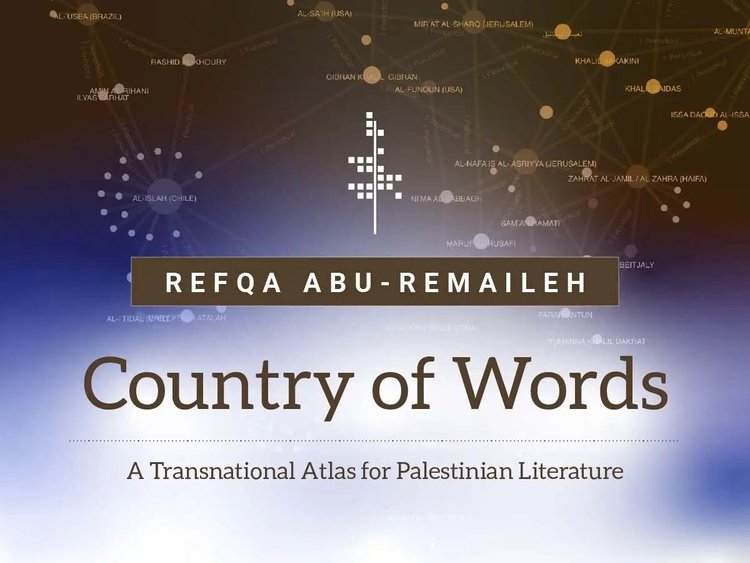
The Center for Palestine Studies, in collaboration with the Middle East Institute at Columbia University, will be hosting Refqa Abu-Remaileh, a scholar of Palestinian literature, to talk about her digital project, Country of Words: A Transnational Atlas for Palestinian Literature. Country of Words: A Transnational Atlas for Palestinian Literature digitally retraces and remaps the global story of Palestinian literature in the 20th century, starting from the Arab world and going through Europe, North America, and Latin America. Sitting at the intersection of literary history, periodical studies, and digital humanities, Country of Words creates a digitally networked and multilocational literary history—a literary atlas enhanced. The virtual realm acts as the meeting place for the data and narrative fragments of this literature-in-motion, bringing together porous, interrupted, disconnected, and discontinuous fragments into an elastic, interconnected, and entangled literary history. Refqa Abu-Remaileh is Associate Professor of Modern Arabic Literature and Film at the Freie Universität Berlin, Germany. As Principal Investigator, she led the European Research Council project PalREAD (2018–2023). She is author of Country of Words: A Transnational Atlas for Palestinian Literature (Stanford University Press, 2023) and creator of the Arabic-language podcast Balad min Kalam: Conversations on Palestinian Literature, available on Spotify and Apple Podcasts. You can explore the Country of Words here. To register for the event on March 5, click here.
|
The world cracked open and Palestine was revealed in all her beauty and pain. This book is a love letter, a prayer for survival, and a poem of resistance.
—Nan Goldin
The Arabic word sumūd is often loosely translated as “steadfastness” or “standing fast.” It is, above all, a Palestinian cultural value of everyday perseverance in the face of Israeli occupation. Sumūd is both a personal and collective commitment; people determine their own lives, despite the environment of constant oppressions imposed upon them. In times of devastation, poetry, literature, and art are the mediums through which oppressed peoples reveal cherished aspects of their existences and remain defiant in the fight for self-determination. Sumūd: A New Palestinian Reader, edited by Malu Halasa and Jordan Elgrably, honors the Palestinian spirit and its power in the face of dispossession and war. When governments around the world enable the genocide of a people and the dilapidation of a sacred homeland, the Palestinian people stand fast and resist. The fifty-eight contributions in this collection remind readers that just as love perseveres, so do the Palestinians, and their struggles and triumphs. This anthology spans the 20th and 21st centuries of Palestinian cultural history, and highlights writing from 2021–2024. The collection of writing and art includes: Dispatches from Hossam Madhoun, co-founder of Gaza's Theatre for Everybody, as he survives the post-October 2023 war on Gaza; Novelist Ahmed Masoud with “Application 39,” a sci-fi short story about a Dystopian bid for the Olympics; Sara Roy and Ivar Ekeland with “The New Politics of Exclusion: Gaza as Prologue,” an analysis of Israel’s divide and conquer policies of fragmentation; Historian Ilan Pappé with a review of Tahrir Hamdi’s book, Imagining Palestine, in which he unpacks the relationship between culture and resistance; Essayist Lina Mounzer with “Palestine and the Unspeakable,” an offering on the language used to dehumanize Palestinians; And poetry by the next generation of poets who have inherited the mantle of the late Mahmoud Darwish (1941–2008).
The essays, stories, poetry, art and personal narrative collected in Sumūd: A New Palestinian Reader is a rich riposte to those who would denigrate Palestinians’ aspirations for a homeland. It also serves as a timely reminder of culture’s power and importance during occupation and war. Just published in January, this book is available in our Bookshop (US / UK).
|
Reading RoundupThe Memory of the City Resisting Genocide – Mariam Mohammed Al Khateeb chronicles the sense memories she has of a Gaza that has turned to rubble: “Gaza is a fragrance that lingers, weaving through autumn clouds heavy with morning dew. Its land carries the scent of orange trees and olive groves, spreading night-blooming lilies before us.” Looking the Palestinian in the Eye – Nicki Kattoura reviews Mohammed El-Kurd’s new book Perfect Victims and the Politics of Appeal, excoriating western outlets like the New York Times that launder Israeli propaganda through a carefully curated and depoliticizing narrative of Palestinian victimhood. Transfer Limits – Muna Mire maps the arduous journey that crowdfunding monies and mutual aid have to take through networks of international solidarity and opportunistic money brokers in order to reach their recipients in Gaza. I to I – Mary Turfah reviews Isabella Hammad’s book Recognizing the Stranger against the backdrop of the slower violence of the ceasefire, arguing that the opposite of the recognition of Palestinian humanity is denial. Days and Nights in Gaza – An excerpt of the book that Muhammad al-Zaqzouq has been writing in Gaza since October 7, 2023, appearing here in Katharine Halls’ translation, which chronicles seeking shelter in the first weeks of the war. For Andreas Malm, the Destruction of Gaza Runs Parallel to the Destruction of the Planet – In this excerpt from The Destruction of Palestine Is the Destruction of the Earth, Andreas Malm examines how the logics of climate destruction are tending toward the kind of imperial indifference witnessed in Gaza since October 2023. Gossiping with My Teta in a Tent of Shadows – Eman Eid reflects on the experience of communing with her grandmother as they prepared food in their tent, concluding that her grandmother’s stories were a refuge in which to survive. Valentine’s Day, During the Time of the War on Gaza – Eman Abdul Karim Mohammed Al-Natour writes here, in M. Lynx Qualey’s translation, of finding hope as she watched people buy withered flowers from a boy selling flowers in Gaza on Valentine’s Day in February 2024. Israel’s Offensive in the West Bank is the Second Act of the Gaza Genocide – Qassam Muaddi tracks the Israeli political logics guiding the intensification of operations in the West Bank, arguing that these represent a prelude to a push to fully annex the West Bank. A Body of Nakedness – A new poem from Palestinian poet Ramzi Salem on finding small moments of solace: “these candles will become a homeland, / painting our silhouettes on the tent’s walls, / multiplying us in warmth and number.”
|
|
PalFest is now on BlueSky! Give us a follow @palfest.bsky.social. Was this email forwarded to you? Sign up to receive it in your inbox.
|
|
|
|