|
This past weekend marked thirty-two years since the signing of the Oslo Accords. From the very beginning, many Palestinians recognized Oslo as a sham. ͏ ͏ ͏ ͏ ͏ ͏ ͏ ͏ ͏ ͏ ͏ ͏ ͏ ͏ ͏ ͏ ͏ ͏ ͏ ͏ ͏ ͏ ͏ ͏ ͏ ͏ ͏ ͏ ͏ ͏ ͏ ͏ ͏ ͏ ͏ ͏ ͏ ͏ ͏ ͏ ͏ ͏ ͏ ͏ ͏ ͏ ͏ ͏ ͏ ͏ ͏ ͏ ͏ ͏ ͏ ͏ ͏ ͏ ͏ ͏ ͏ ͏ ͏ ͏ ͏ ͏ ͏ ͏ ͏ ͏ ͏ ͏ ͏ ͏ ͏ ͏ ͏ ͏ ͏ ͏ ͏ ͏ ͏ ͏ ͏ ͏ ͏ ͏ ͏ ͏ ͏ ͏ ͏ ͏ ͏ ͏ ͏ ͏ ͏ ͏ ͏ ͏ ͏ ͏ ͏ ͏ ͏ ͏ ͏ ͏ ͏ ͏ ͏ ͏ ͏ ͏ ͏ ͏ ͏ ͏ ͏ ͏ ͏ ͏ ͏ ͏ ͏ ͏ ͏ ͏ ͏ ͏ ͏ ͏ ͏ ͏ ͏ ͏ ͏ ͏ ͏ ͏ ͏ ͏ ͏ ͏ ͏ ͏ ͏ ͏ ͏ ͏ ͏ ͏ ͏ ͏ ͏ ͏ ͏ ͏ ͏ ͏ ͏ ͏ ͏ ͏ ͏ ͏ ͏ ͏ ͏ ͏ ͏ ͏ ͏ ͏ ͏ ͏ ͏ ͏ ͏ ͏ ͏ ͏ ͏ ͏ ͏ ͏ ͏ ͏ ͏ ͏ ͏ ͏ ͏ ͏ ͏ ͏ ͏ ͏ ͏ ͏ ͏ ͏ ͏ ͏ ͏ ͏ ͏ ͏ ͏ ͏ ͏ ͏ ͏ ͏ ͏ ͏ ͏ ͏ ͏ ͏ ͏ ͏ ͏ ͏ ͏ ͏ ͏ ͏ ͏ ͏ ͏ ͏ ͏ ͏ ͏ ͏ ͏ ͏ ͏ ͏ ͏ ͏ ͏ ͏ ͏ ͏ ͏ ͏ ͏ ͏ ͏ ͏ ͏
The Oslo Accords and The Morning After
|
|
This past weekend marked thirty-two years since the signing of the Oslo Accords, an agreement in which the PLO formally recognized the Israeli state, abandoned armed struggle, and established the Palestinian Authority (PA) in the West Bank as a transitional government on the putative path to a “two-state solution.” From the very beginning, many Palestinians recognized Oslo as a sham. Mahmoud Darwish, for example, called the Oslo Accords “an Israeli solution to Israeli problems” that left the PLO “diminished.” Edward Said called it a “premature alliance” between the PLO and Israel. This was because the Oslo Accords not only codified the fragmentation of the West Bank into three separately administered areas; they also cemented the architecture of the occupation, emboldened the settler movement, and divided the national liberation movement. More than thirty years since Oslo, the PA continues to cling to its “transitional” power as a willful collaborator with the occupation; the Zionist settler movement has grown more brazen in its colonization of the so-called “disputed territories,” the Palestinian economy is held in near-total thrall by Israel, and Israel maintains its siege on Gaza through its exclusive monopoly over Gaza’s land, sea, and air borders. The Oslo Accords, and the promise of peace that they never delivered, were thus, in the words of one commentator, “the war Israel won without fighting.” Below, you can read an excerpt of The Morning After, Edward Said’s appraisal of the Oslo Accords, written soon after their signing in October 1993. With Western governments warming to the prospect of recognizing a Palestinian state, Said’s pessimistic reading of the Oslo Accords is a prescient warning about the beguiling fallacy of the two-state solution.
|
The Morning After by Edward Said
|
|
Now that some of the euphoria has lifted, it is possible to re-examine the Israeli-PLO agreement with the required common sense. What emerges from such scrutiny is a deal that is more flawed and, for most of the Palestinian people, more unfavourably weighted than many had first supposed. The fashion-show vulgarities of the White House ceremony, the degrading spectacle of Yasser Arafat thanking everyone for the suspension of most of his people’s rights, and the fatuous solemnity of Bill Clinton’s performance, like a 20th-century Roman emperor shepherding two vassal kings through rituals of reconciliation and obeisance: all these only temporarily obscure the truly astonishing proportions of the Palestinian capitulation. So first of all let us call the agreement by its real name: an instrument of Palestinian surrender, a Palestinian Versailles. What makes it worse is that for at least the past fifteen years the PLO could have negotiated a better arrangement than this modified Allon Plan, one not requiring so many unilateral concessions to Israel. For reasons best known to the leadership it refused all previous overtures. To take one example of which I have personal knowledge: in the late Seventies, Secretary of State Cyrus Vance asked me to persuade Arafat to accept Resolution 242 with a reservation (accepted by the US) to be added by the PLO which would insist on the national rights of the Palestinian people as well as Palestinian self-determination. Vance said that the US would immediately recognise the PLO and inaugurate negotiations between it and Israel. Arafat categorically turned the offer down, as he did similar offers. Then the Gulf War occurred, and because of the disastrous positions it took then, the PLO lost even more ground. The gains of the intifada were squandered, and today advocates of the new document say: ‘We had no alternative.’ The correct way of phrasing that is: ‘We had no alternative because we either lost or threw away a lot of others, leaving us only this one.’ In order to advance towards Palestinian self-determination – which has a meaning only if freedom, sovereignly and equality, rather than perpetual subservience to Israel, are its goal – we need an honest acknowledgment of where we are, now that the interim agreement is about to be negotiated. What is particularly mystifying is how so many Palestinian leaders and their intellectuals can persist in speaking of the agreement as a ‘victory’. Nabil Shaath has called it one of ‘complete parity’ between Israelis and Palestinians. The fact is that Israel has conceded nothing, as former Secretary Of State James Baker said in a TV interview, except, blandly, the existence of ‘the PLO as the representative of the Palestinian people’. Or as the Israeli ‘dove’ Amos Oz reportedly put it in the course of a BBC interview, ‘this is the second biggest victory in the history of Zionism.’ By contrast Arafat’s recognition of Israel’s right to exist carries with it a whole series of renunciations: of the PLO Charter; of violence and terrorism; of all relevant UN resolutions, except 242 and 338, which do not have one word in them about the Palestinians, their rights or aspirations. By implication, the PLO set aside numerous other UN resolutions (which, with Israel and the US, it is now apparently undertaking to modify or rescind) that, since 1948, have given Palestinians refugee rights, including either compensation or repatriation. The Palestinians had won numerous international resolutions – passed by, among others, the EC, the non-aligned movement, the Islamic Conference and the Arab League, as well as the UN – which disallowed or censured Israeli settlements, annexations and crimes against the people under occupation. It would therefore seem that the PLO has ended the intifada, which embodied not terrorism or violence but the Palestinian right to resist, even though Israel remains in occupation of the West Bank and Gaza. The primary consideration in the document is for Israel’s security, with none for the Palestinians’ security from Israel’s incursions. In his 13 September press conference Rabin was straightforward about Israel’s continuing control over sovereignty; in addition, he said, Israel would hold the River Jordan, the boundaries with Egypt and Jordan, the sea, the land between Gaza and Jericho, Jerusalem, the settlements and the roads. There is little in the document to suggest that Israel will give up its violence against Palestinians or, as Iraq was required to do after it withdrew from Kuwait, compensate those who have been the victims of its policies over the past 45 years.
|
|
Neither Arafat nor any of his Palestinian partners who met the Israelis in Oslo has ever seen an Israeli settlement. There are now over two hundred of them, principally on hills, promontories and strategic points throughout the West Bank and Gaza. Many will probably shrivel and die, but the largest are designed for permanence. An independent system of roads connects them to Israel, and creates a disabling discontinuity between the main centres of Palestinian population. The actual land taken by these settlements, plus the land designated for expropriation, amounts – it is guessed – to over 55 per cent of the total land area of the Occupied Territories. Greater Jerusalem alone, annexed by Israel, comprises a huge tranche of virtually stolen land, at least 25 per cent of the total amount. In Gaza settlements in the north (three), the middle (two) and the south, along the coast from the Egyptian border past Khan Yunis (12), constitute at least 30 per cent of the Strip. In addition, Israel has tapped into every aquifer on the West Bank, and now uses about 80 per cent of the water there for the settlements and for Israel proper. (There are probably similar water installations in Israel’s Lebanese ‘security zone’.) So the domination (if not the outright theft) of land and water resources is either overlooked, in the case of water, or, in the case of land, postponed by the Oslo accord. What makes matters worse is that all the information on settlements, land and water is held by Israel, which hasn’t shared most of these data with the Palestinians, any more than it has shared the revenues raised by the inordinately high taxes it has imposed on them for 26 years. All sorts of technical committees (in which non-resident Palestinians have participated) have been set up by the PLO in the territories to consider such questions, but there is little evidence that committee findings (if any) were made use of by the Palestinian side in Oslo. So the impression of a huge discrepancy between what Israel got and what the Palestinians conceded or overlooked remains unrectified. I doubt that there was a single Palestinian who watched the White House ceremony who did not also feel that a century of sacrifice, dispossession and heroic struggle had finally come to nought. Indeed, what was most troubling is that Rabin in effect gave the Palestinian speech while Arafat pronounced words that had all the flair of a rental agreement. So far from being seen as the victims of Zionism, the Palestinians were characterised before the world as its now repentant assailants: as if the thousands killed by Israel’s bombing of refugee camps, hospitals and schools in Lebanon; Israel’s expulsion of 800,000 people in 1948 (whose descendants now number about three million, many of them stateless); the conquest of their land and property; the destruction of over four hundred Palestinian villages; the invasion of Lebanon; the ravages of 26 years of brutal military Occupation – it was as if these sufferings had been reduced to the status of terrorism and violence, to be renounced retrospectively or passed over in silence. Israel has always described Palestinian resistance as terrorism and violence, so even in the matter of wording it received a moral and historical gift. In return for exactly what? Israel’s recognition of the PLO – undoubtedly a significant step forward. Beyond that, by accepting that questions of land and sovereignty are being postponed till ‘final Status negotiations’, the Palestinians have in effect discounted their unilateral and internationally acknowledged claim to the West Bank and Gaza: these have now become ‘disputed territories’. Thus with Palestinian assistance Israel has been awarded at least an equal claim to them. The Israeli calculation seems to be that by agreeing to police Gaza – a job which Begin tried to give Sadat fifteen years ago – the PLO would soon fall foul of local competitors, of whom Hamas is only one. Moreover, rather than becoming stronger during the interim period, the Palestinians may grow weaker, come more under the Israeli thumb, and therefore be less able to dispute the Israeli claim when the last set of negotiations begins. But on the matter of how, by what specific mechanism, to get from an interim status to a later one, the document is purposefully silent. Does this mean, ominously, that the interim stage may be the final one? Read more of Edward Said’s 1993 essay on the Oslo Accords.
|
Applications open for the Palestine Film Fund
|
|
The Palestine Film Fund (PFF) call for submissions opens today! Launched by the Palestine Film Institute in May 2025, the Palestine Film Fund provides essential financial and professional support for Palestinian filmmakers worldwide, regardless of where they live or what passport they carry. It was established to ensure that Palestinians have the right to tell their own stories, shape their own narratives and control their own images of experiences, struggles, and hopes. The Fund supports filmmakers, at every stage of their journey, through grants ranging from €3,000 to €15,000 to turn their ideas into films that reach global audiences and establish the solid foundation for a sustainable creative ecosystem where Palestinian voices can thrive. Applications are open to projects by Palestinian directors residing in Palestine or the diaspora - there are no residence requirements beyond nationality/origin. Applications are due by 31 October. You can find more details about eligibility and apply for the Fund at the Palestine Film Institute website.
|
Writing Palestine: Voices of Resistance with Susan Abulhawa, 25 September
|
|
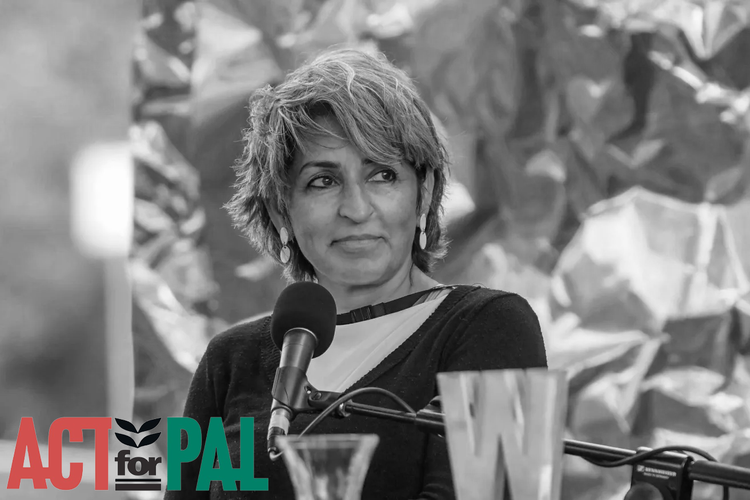
On 25 September, Academic Action Network for Palestine will be hosting a virtual roundtable conversation with the novelist and activist Susan Abulhawa. In conversation with Tahrir Hamdi, Dalia Mostafa and Naema Aldaqsha, Susan Abulhawa will answer questions on her literature that centres Palestine’s history and resistance to Zionist settler colonialism. Beyond her fiction, the conversation will also explore Abulhawa’s passionate activism, her vision for Palestinian liberation, and her thoughts on the global Palestine Solidarity Movement. The webinar is happening at 5pm BST / 12pm EDT on 25 September. You can register here.
|
From West Cornwall to the West Bank, 27 September
|
|
Join Wildworks and the Blend Choir for an evening of solidarity and song, From West Cornwall to the West Bank. Wildworks travelled to the West Bank in 2010, as participants in Palfest, the Palestinian Festival of Literature and then in 2013 to create “Nablus, City of Stories” in collaboration with the people of Nablus and the adjacent refugee camps, New Askar and old Askar. Wildworks was hosted by Project Hope, an organisation providing education and cultural services to the city. The situation has become a lot worse since then. This event, as a consequence, is to support Project Hope in their unstinting work for their communities, and to show solidarity with them at a time when forced displacement and unlawful killings are progressing apace in the West Bank. Mercedes Kemp, Vicky Abbott and Julie Macara and the Blend Choir have worked with Hakim Sabbah of Project Hope and Palestinian musician Habib Al Deek to co-create an evening of song, spoken word, sonic meditations and circle songs in solidarity with the people of Palestine. The evening will also feature The Tinners Session Band and Wolf Gang. All money raised through ticket and drinks sales and additional donations will be donated to Project Hope in Nablus. Find more details and purchase your tickets here. If you can’t make it, please consider supporting the work of Project Hope as well.
|
With formidable rigour, sophistication, and tenacity, Hamid Dabashi situates Palestine at the heart of a global struggle for liberation from the age of European colonialism. After Savagery places the reader on a daring path to build a new world that is fit for the ‘total human beings’ that we are and aspire to be. Dabashi resolutely and defiantly insists that after savagery must come a committed intellectual and political project of resuscitating our collective humanity. – Muhannad Ayyash
Written during a genocide, After Savagery reveals the ethical bankruptcy of “Western philosophy” and how it undergirds the erasure of the colonized. The death toll in Gaza continues to rise―a cold, lifeless number representing entire communities crushed under the weight of settler colonialism. What remains of the theories we use to understand our world? With lyrical and lucid fury, Hamid Dabashi exposes the racist roots of Western philosophy, demanding that readers overcome its pernicious phantom of relevance. Rather than perceiving “the West” as giving carte blanche to Israel, Dabashi insists that Israel must be understood as its quintessence. If Israel is the West and the West is Israel, then Palestine is the world and the world is Palestine. Holding to glimmers from revolutionary works of literature and film, Dabashi argues, in grief and love, that the wretched of the earth need poetry after barbarism—and that Palestine is the site of a liberated imagination. After Savagery publishes later this month. You can preorder the book in our Bookshop (US / UK).
|
Media RoundupHow is the Occupation Strangling the Palestinian Economy? – In this essay translated by Shady Hamada, Rasheed Ali examines different ways that Israel seems to be engineering the PA’s fiscal collapse – for instance, by preventing Palestinian banks from buying foreign currency and withholding duly owed tax monies – for which “the goal is not to manage the Palestinian economy but to expropriate the land beneath it.” Renowned Gaza Journalist Wael Dahdouh: ‘Journalism Is Not a Job, It's a Mission’ – Shahla Omar profiles Wael al-Dahdouh about how surprised he was at Western media coverage of the genocide, and how he sees Gazan journalists as altering the profession for the rest of the world. What It Takes to Be a Palestinian Journalist – Qassam Muaddi looks at how Israel has targeted Palestinian writers and journalists for decades, arguing that Gazan journalists are the inheritors of Kanafani’s legacy, and showcasing what drives these journalists to continue their coverage: “For us, the job is to open a window into the reality of our people. It’s an ethical duty above everything else.” Never Again for All, or for No One – Sean Pergola reports on the recent controversy around the Los Angeles Holocaust Museum’s apology after claiming that “never again means never again for anyone,” proving thereby the Palestine exception to liberal humanism. Our Garden's Plants Saved Us from Hunger – Writing from Gaza, Mariam Mushtaha tells of her family cultivating plants in the courtyard of the building where they have found shelter, maintaining their connection to the land even as they have been severed from the farm they once had. Gaza Flotilla Participant: “Gaza Can’t Wait” – Branko Marcetic interviews David Adler, a participant in the Global Sumud Flotilla, about the resilience of the crews and the mission despite the risks involved and the drone attacks, and the conviction they share to break the siege. Israel's Attack on Qatar Should Be a Wake-up Call for the Arab World – Mohamad Elmasry argues that Arab states engaged in normalization with Israel are not, and have never been, safe from Israel’s belligerence. The Disappearance of Dr. Hussam Abu Safiya – Amel Guettatfi reports on Israel’s ongoing detention of Dr. Hussam Abu Safiya since his detention in December 2024 after the Israeli military’s raid on Kamal Adwan Hospital There Is Nowhere Left to Go – We Are Trapped – Writing from northern Gaza amid Israel’s expanding assault on Gaza City, Malak Hijazi describes the climate of fear and helplessness as the wholesale destruction of the city’s landmarks mounts. "This is the moment of accountability" w/ Michael Fakhri – On this episode of Makdisi Street, the UN Special Rapporteur on the Right to Food Michael Fakhri speaks about the open war of starvation on Gaza and the emerging prospects for holding Israel – and complicit governments and institutions – accountable for the genocide. In This Labyrinth – A new poem by Najwan Darwish, translated by Kareem James Abu-Zeid: “I’m made of earth, / so why should I care / if I’m crumbled / or scattered on the land? / It was in this labyrinth, / in it alone, / that I found my way.”
|
|
Consider subscribing to the PalFest Bookshelf to receive a curated selection of the finest new and classic books by Palestinian writers. Was this email forwarded to you? Sign up to receive it in your inbox.
|
|
|
|