|
Randa Abdel-Fattah’s new novel, DISCIPLINE, on the PalFest Bookshelf & the PalFest Podcast. ͏ ͏ ͏ ͏ ͏ ͏ ͏ ͏ ͏ ͏ ͏ ͏ ͏ ͏ ͏ ͏ ͏ ͏ ͏ ͏ ͏ ͏ ͏ ͏ ͏ ͏ ͏ ͏ ͏ ͏ ͏ ͏ ͏ ͏ ͏ ͏ ͏ ͏ ͏ ͏ ͏ ͏ ͏ ͏ ͏ ͏ ͏ ͏ ͏ ͏ ͏ ͏ ͏ ͏ ͏ ͏ ͏ ͏ ͏ ͏ ͏ ͏ ͏ ͏ ͏ ͏ ͏ ͏ ͏ ͏ ͏ ͏ ͏ ͏ ͏ ͏ ͏ ͏ ͏ ͏ ͏ ͏ ͏ ͏ ͏ ͏ ͏ ͏ ͏ ͏ ͏ ͏ ͏ ͏ ͏ ͏ ͏ ͏ ͏ ͏ ͏ ͏ ͏ ͏ ͏ ͏ ͏ ͏ ͏ ͏ ͏ ͏ ͏ ͏ ͏ ͏ ͏ ͏ ͏ ͏ ͏ ͏ ͏ ͏ ͏ ͏ ͏ ͏ ͏ ͏ ͏ ͏ ͏ ͏ ͏ ͏ ͏ ͏ ͏ ͏ ͏ ͏ ͏ ͏ ͏ ͏ ͏ ͏ ͏ ͏ ͏ ͏ ͏ ͏ ͏ ͏ ͏ ͏ ͏ ͏ ͏ ͏ ͏ ͏ ͏ ͏ ͏ ͏ ͏ ͏ ͏ ͏ ͏ ͏ ͏ ͏ ͏ ͏ ͏ ͏ ͏ ͏ ͏ ͏ ͏ ͏ ͏ ͏ ͏ ͏ ͏ ͏ ͏ ͏ ͏ ͏ ͏ ͏ ͏ ͏ ͏ ͏ ͏ ͏ ͏ ͏ ͏ ͏ ͏ ͏ ͏ ͏ ͏ ͏ ͏ ͏ ͏ ͏ ͏ ͏ ͏ ͏ ͏ ͏ ͏ ͏ ͏ ͏ ͏ ͏ ͏ ͏ ͏ ͏ ͏ ͏ ͏ ͏ ͏ ͏ ͏ ͏ ͏ ͏ ͏ ͏ ͏ ͏ ͏ ͏ ͏ ͏ ͏ ͏ ͏
From the PalFest Bookshelf:
|
Discipline by Randa Abdel-Fattah
|
|
Our final Bookshelf selection for 2025 is Discipline, a novel by Randa Abdel-Fattah, just published in Australia and currently exclusively available outside of Australia via the Bookshelf. With a focus on two of today’s most contested fields, academia and the media, Discipline tallies the price we all pay when those with privilege choose to remain silent. As Israel’s bombardment of Gaza intensifies into the final weeks of Ramadan, academic Ashraf and young journalist Hannah must reckon with their choices, values and places in their communities. Will they be prepared to make sacrifices in the pursuit of what is right?
|
|
Randa Abdel-Fattah is the latest guest on the PalFest Podcast, where she speaks to our own Sara Yasin about Discipline and the many issues it raises. It's a brilliant, lively, personal, uncompromising conversation that goes deep into the cultural architecture of Western liberal institutions - and why they are "collapsing before our eyes." And you can watch (or listen) to it now.
|
|
Help us to support bold publishing on Palestine by subscribing to the Bookshelf at the link in our bio and receive the December/January selection as your first shipment. Learn more about the book, and subscribe to the PalFest Bookshelf, here. And consider subcribing to the PalFest Podcast for more conversations like the one above.
|
NEW YORK: We Never Imagined All the Cameras Would be Useless, 9 December
|
|
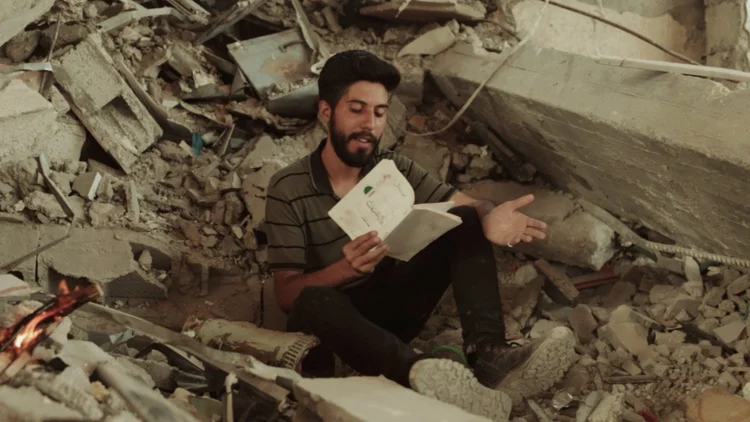
The Gaza Biennale and the Forbidden Museum of Al Risan Mountain, in collaboration with Recess and e-flux Screening Room, present films by Emad Badwan and Yahya Alsholy, filmmakers and artists working in Gaza today. The works of Badwan and Alsholy challenge the ubiquitous image of life in Gaza, fusing fact and fiction to capture the material and unconscious realities of a life distorted by genocide, pushing the medium to its limits. The screening will be presented alongside a pre-recorded conversation with the filmmakers, moderated by Farah Barqawi and Omar Berrada. These films are part of the New York Pavilion of the Gaza Biennale, on view at Recess through December 20, 2025. Films: Emad Badwan, Live Broadcast بث مباشر
(2025, 10 minutes. Produced in Deir al-Balah)
A journalist leaves his reporting station just minutes before his live broadcast, to go to the restroom. In the long queue of impatient people, the war is discussed by those waiting in line. Some praise the photographer, while others criticize him for not covering a particular incident or for not being at a certain location during a specific event. The photographer’s tense state and need to use the restroom continue to rise until he reluctantly returns to the live broadcast to cover an ongoing massacre. The story is humorous and painful, capturing the often-overlooked, quotidian struggles of refugees surviving amidst a genocide. Yahya Alsholy, Escape from Farida الهروب من فريدة
(2025, 15 minutes. Produced in North Gaza)
A film about a young man whose aspirations are shattered in the alleys of a city altered by war. He tries to rid himself of his past and leave. However, he must confront his fiancée Farida with his decision to leave the city, igniting memories and contradictions within him. Yahya Alsholy, The Curse of Children Who Grew Up from Oranges لعنة الأطفال الذين نشأوا من البرتقال
(2025, 2 minutes. Produced in Jabalia)
How do children experience the violence of genocide in Gaza, an extreme situation that distorts their sense of normalcy? This question guides Yayha Alsholy in his video, The Curse of Children Who Grew Up from Oranges, where reality and illusion blend into one another. A nightmare from which one cannot escape, the video is at the same time interspersed with images of lushness and the sight of a fresh orange. The ambivalence of the passports that at once shape our lives but have no material value become seeds of growth among the horrific perception of the surrounding violence. Alluding to how children, tremendously affected by the Israeli onslaught on Gaza, perceive these events in illogical ways, the video conveys the complexity of experiences through a combination of staged scenes and real footage overlaid by the color of oranges. Yahya Alsholy, Completely Invisible غير مرئي تماما
(2025, 2 minutes. Produced in North Gaza)
This video work sketches scenes reflected in the eyes of children, observed by the eyes watching them, giving us images of their imagination as they try to interpret the cruelty of what surrounds them, amid a visual chaos shaped mercilessly by war. In this closed frame, with their besieged eyes and their stained imaginations, the children find no refuge except to surrender to watching, under the weight of a constant feeling of being small, and a deep-rooted sense that they are melting into the shadow, without trace, without presence, completely invisible.
Find out more and get your tickets here.
|
TORONTO: Palestine & Feminist Liberation Book Launch, 11 December
|
|
A Space Gallery and Between the Lines present the closing reception of the Gaza Biennale T’karonto and the book launch of Palestine and Feminist Liberation. In Palestine and Feminist Liberation, Palestinian scholar-activist Nada Elia argues that Palestinian women, far from being powerless and submissive, have long played an important role in resisting their people’s dispossession, first by the British Mandate, then by Israel. Elia discusses the challenges diaspora Palestinian feminists face when organizing on Turtle Island, where the dominant discourse has long upheld the Zionist narrative, steeped in Orientalism and anti-Palestinian racism. She articulates a vision for liberation grounded in Indigenous feminism, with its focus on collective empowerment, rather than individual advancement. The book launch is being held in tandem with the closing reception of the Gaza Biennale in T’karonto. Since April 2024, artists from Gaza began to gather together under a single project, to find ways to utilize art to resist this genocide. Many artists in Gaza have been working throughout this war, defying all challenges, creating works that remind us that art is essential to life and our survival as a species. A collective project has emerged into a global art event, the Gaza Biennale. In T’karonto, the 2025 Gaza Biennale is presented by A Space Gallery and Gallery TPW. Find out more and reserve your free tickets here.
|
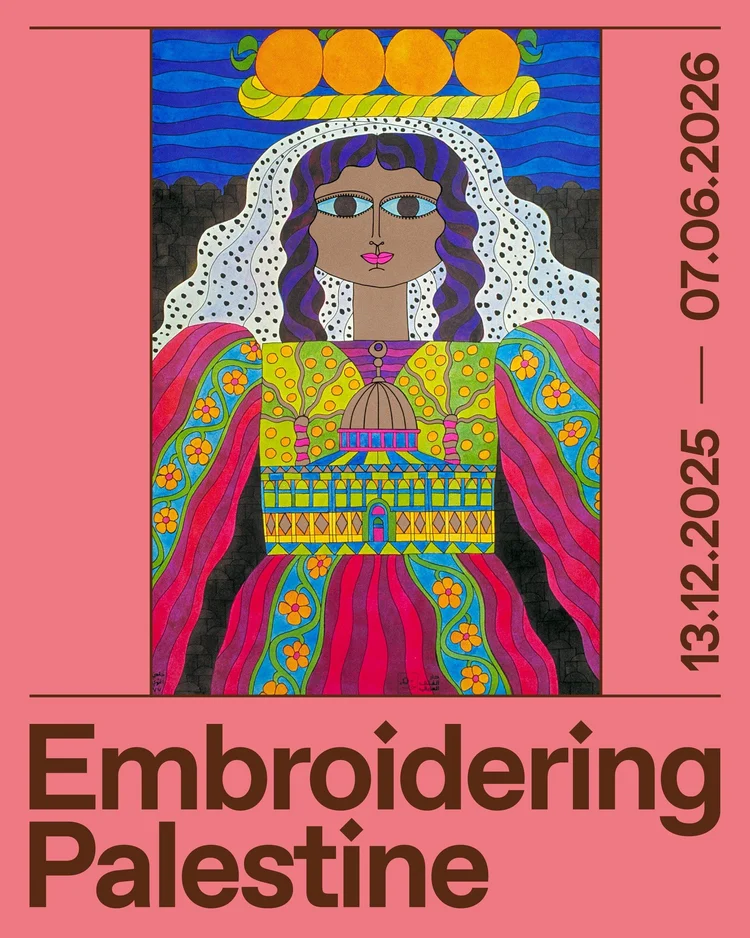
ANTWERP: Embroidering Palestine, opening 13 December
|
|
Embroidery, called tatreez in Arabic, is one of the most important cultural practices of Palestine. Historically, Palestinian fashion was defined by diversity, with every region known for distinct textiles, styles and stitchwork. More than a craft, tatreez in the nineteenth and early twentieth centuries was a visual language shared by women, as embroidery reflected its maker’s identity and origins. This exhibition at MoMu in Antwerp explores Palestinian embroidery and dress through the lenses of nature, splendour, power and change. Tatreez was a rural craft, embedded in women’s relationship to nature – from motifs inspired by Palestinian flora, to fabrics dyed with indigo grown in the Galilee. At the same time, the splendour of embroidery attested to women’s wealth and status. The wedding was a vital rite of passage, with sumptuous clothing a key element of celebrations. Golden thread, mother-of-pearl shoes, and elaborate headdresses offer a spectacular glimpse of local craftsmanship. Silver jewellery, along with certain tatreez motifs, also held talismanic significance, reflecting the power of clothing to affect and protect the body. Today, embroidery’s power lies in its connection to Palestinian identity, as a symbol of resistance and solidarity. Since the Nakba, or catastrophe, of 1948, which refers to the mass displacement and dispossession of hundreds of thousands of Palestinians, and the establishment of the state of Israel, tatreez has become a form of cultural resistance, an assertion of identity. The exhibition traces the politicisation of the craft, the role of textiles in the assertion of identity, and the continued inspiration tatreez provides to Palestinian fashion designers in the present. The exhibition brings together important objects on loan from the Musée du Quai Branly – Jacques Chirac in Paris, the Textile Research Centre in Leiden, and the Wereldmuseum in the Netherlands. Weaving together the historical and the contemporary, the show celebrates the rich cultural heritage of Palestine’s past alongside the designers shaping its future – including work by Ayham Hassan, GmbH, Reemami, Studio Nazzal and Zeid Hijazi. Find out more about the exhibition, including related events, tours, and talks, here.
|
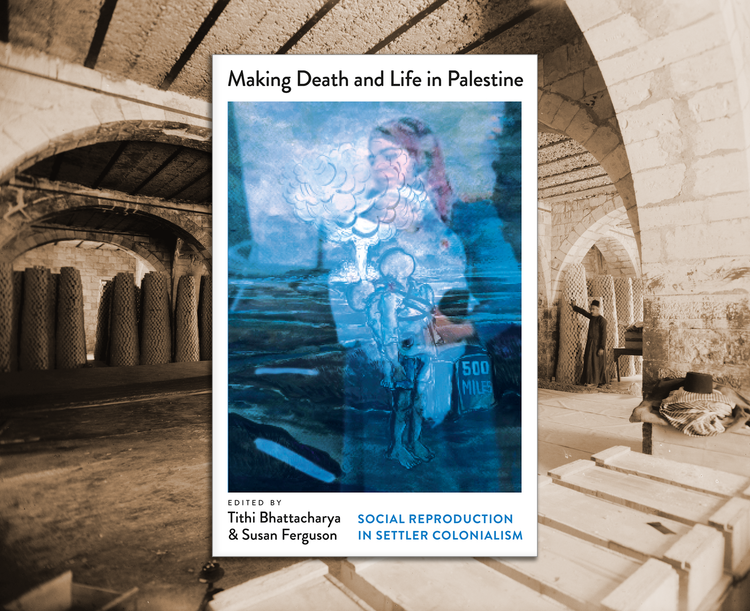
In this important edited volume, two pioneering figures in Social Reproduction Theory, Tithi Bhattacharya and Sue Ferguson, extend their framework beyond the working-class struggle for life in advanced capitalist societies, accounting for the specificity of settler-colonial capitalism. The essays they have assembled here urgently address the contemporary case study of Palestine in the horrific era of the Gaza genocide. They reveal the intensity of the battle between the exterminationist death-making force of Israeli colonialism and the Palestinian determination to produce and sustain a flourishing and liberated collective life. – Abdel Razzaq Takriti
Social reproduction theory is a big idea. It explores how the daily renewal of human life, and therefore human labour, is essential to capitalism. Here, in Making Death and Life in Palestine, leading feminists come together to apply the theory to one of its most extreme settings – that of Palestine. Israel’s settler colonialism is premised on the eradication of Palestinian lives, undermining Palestinian social reproduction at every turn. This project, which ramped up after October 7th, does have a logic, and by examining the concrete, historically specific details, the authors begin to reshape and refine the theory of Social Reproduction, shedding light on why Israel’s assault is so brutal. Chapters look at Israel’s mass murder of a generation of Palestinians in Gaza, the effects of ecocide, the relationship between land dispossession and class, Israel’s selective pronatalism, scholasticide and other topics. By understanding this deadly logic, we can look deeper into the heart of the evils of capitalism, and stand in solidarity with Palestine. Making Death and Life in Palestine is out now from Pluto Press. You can get your copy from our Bookshop (US / UK)
|
Media RoundupWatched, Tracked, Targeted: Life Under Surveillance in Gaza – Mohammed Mhawish reports on how the sprawling infrastructure of Israeli surveillance in Gaza has grown more omnipresent and more advanced, leading to “the collapse of connection itself: the way fear moves into a family, one phone call at a time, until even expressions of love begin to feel dangerous.” Bride at the Refugee Camp: Notes on Martyrdom and the Palestinian Wedding-Funeral – Laura Al-Tibi considers the overlapping affects and sociopolitical logics at play in both funerals and weddings in Palestine: “As the wedding-funeral fulfills the martyred groom’s denied rites of passage, encoding his sacrifice as a marriage to the homeland, the bride is robbed of her own rites and left to grieve their unattainable union.” A Single, Slow Exorcism: The Nakba Dreamed Backwards – Fifi Bat-hef reviews Palestine -1, a new collection of short stories that imagines Palestine as it was one year before the Nakba, suggesting that the collection “leaves no room for the comforting Zionist fiction that the land was ever empty, or waiting.” A Bomb for Personal Use – An excerpt from Mirna al-Mahdi’s Arabic-language novel, translated by Rana Asfour, which follows a cast of characters from diverse backgrounds, including Armenian refugees, living under occupation and political pressure. An Unwritten Poem – A new short story by Omar Khalifah, translated by Barbara Romaine, in which a young Palestinian in New York finds his poetic aspirations challenged when he encounters one of his countrymen, to whom he bears an uncanny resemblance: “My name was there on all the pages. Was I the author of these poems? Could I possibly ascribe them to myself?” Trump, Gaza, and Oslo Déjà Vu – Jeremy Scahill and Jawa Ahmad consider how the Palestinian Authority is aligning itself with the US-led “peace” plan for Gaza, raising questions about the future of the struggle for Palestinian unification and liberation. How Britain Entrenched Zionist Impunity in Palestine – Ghada Karmi examines the political moment of the Balfour Declaration in 1917 and its aftermath to argue that Britain played a crucial role in cementing the logics of Jewish exceptionalism and the will to colonize in the fabric of the State of Israel. Between Ceasefires: Who, In Gaza, Can Ever Truly Return Home? – Khaled Al-Qershali writes about how Israel’s recurring violations of the ceasefire, and its threats of expanded military action, have prevented displaced Gazans from opting to return to their destroyed homes and neighborhoods in the north of Gaza. Looking at America From Gaza – In this essay translated by Katharine Halls, Muhammad al-Zaqzouq writes about how an image of America came into focus from his perspective in Gaza, beginning in the early 2000s and culminating after October 7, 2023, as a global superpower that topples regimes: “Why, if America has the power, does it not stop the war? How does America see Gaza? Who are we in their eyes? Is Gaza in Americans’ perceptions just another war zone? A closed-off, insular society of extremists? Does the average American, outside the institutions of power, know what pain and suffering we are living through? Can this awareness — if it exists — exert any pressure on the U.S. government to stop the war?” The Gaza Genocide Has Not Ended. It Has Only Changed Its Form. – Hassan Abo Qamar reports on how the ceasefire has, due to the ongoing blockade on food, medicine, and other necessary aid, merely abandoned Gazans to “engineered stagnation–punishment disguised as calm.” An Unholy Precedent – In this profile of Nida Abu Baker, daughter of the still-incarcerated founder of the Holy Land Foundation, Shukri Abu Baker, Sarah O’Neal writes about the parallels between the post-9/11 moment and the current moment, and about the necessity of strengthening the prison solidarity efforts of the movement for Palestine in the US. Inside the Campaign to Block Israel’s Warships – In this podcast, Laicie Heeley reports on how the Palestine solidarity work taking place in ports and among longshore workers to disrupt the flow of weapons to Israel has divided unions and highlighted obstacles to organizing labor. How the World Can Resist the UN Security Council’s Rogue Colonial Mandate in Gaza – Craig Mokhiber examines what measures the rest of the United Nations might be able to take in order to dismantle the UN Security Council’s resolution adopting a so-called peace plan for Gaza. Of Weapons and Words – In this essay first published two years ago and newly translated by Al-Rifaq, Amer Mohsen writes of the role of armed struggle in developing political theory and of the revolutionary uses of certainty: “‘Certainty’, for me, is when you believe in something, are convinced of it, and commit to it to the extent that you accept the possibility of victory just as you accept the possibility of defeat—because it is the right choice, or the only choice.”
|
|
Consider subscribing to the PalFest Bookshelf to receive a curated selection of the finest new and classic books by Palestinian writers. Was this email forwarded to you? Sign up to receive it in your inbox.
|
|
|
|